Medical Device Registration Timelines: Indonesia, Saudi Arabia & Brazil
"How long does registration take?" is hard to answer in one sentence
Three Markets
One Registration Timeline
Indonesia NIE · Saudi MDMA · Brazil ANVISA · Fastest 30 days · Longest 22 months
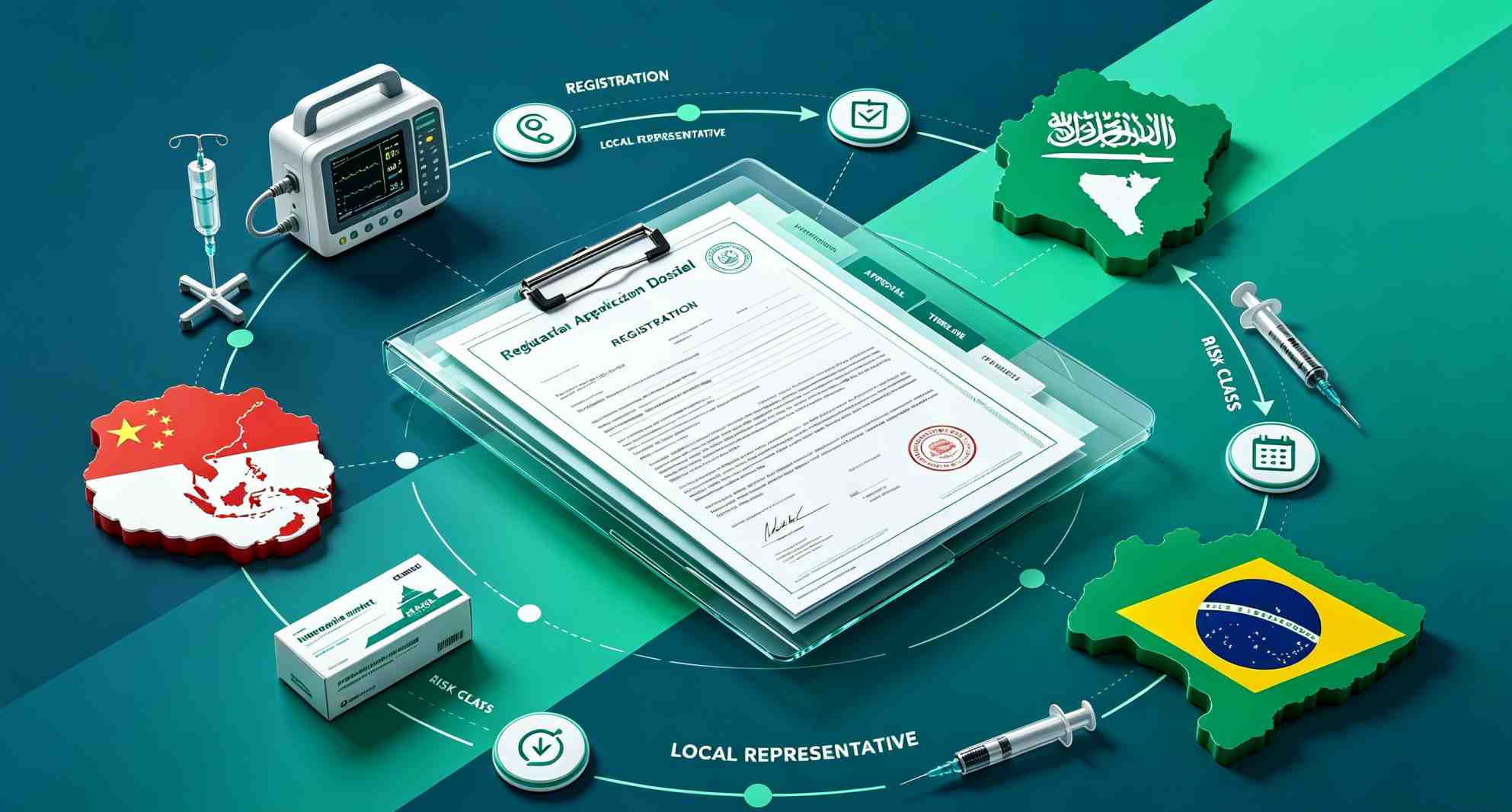
The question we get asked the most
"How long does registration take in this market?"
Among our most-asked questions, this is the hardest to answer in one sentence. The answer depends on three things: the product's risk class, whether the documents are complete, how reliable the local representative is.
Worse, many guides online are outdated. The typical case is Saudi Arabia — some sources still cite "low-risk products via MDL fast registration, getting a number in 1–4 weeks", but this route was discontinued in 2022.
In this article, we break down the current registration pathways in Indonesia, Saudi Arabia and Brazil: risk classes, procedures, required documents, actual timelines and where the money goes.
Scope Note
Based on publicly available information as of September 2026. Regulations and review timelines may change; cycles cited are industry ranges, not official commitments. Actual timelines depend on product class, documentation completeness, and rounds of deficiency response. Confirm with the latest official announcements.
Three common points first
THREE CONSTANTS · Unavoidable in all three countries
Before going country by country, three requirements apply across all three markets. Settle them first to save a lot of repetitive work later.
1. Local representative is mandatory and holds the certificate
None of the three countries accepts direct applications from overseas manufacturers. Indonesia requires a local license holder (with IDAK + CDAKB qualifications), Saudi Arabia requires a local Authorized Representative (AR), and Brazil requires a Brazilian Registration Holder (BRH).
The key is not "whether to find one", but under whose name the registration number is held. In all three markets, the certificate belongs to the local representative; changing representatives means transferring the registration, which is heavy work and the most dispute-prone part later.
2. ISO 13485 is a prerequisite, not a bonus
All three markets treat ISO 13485 as the basic entry threshold. Brazil goes further: Class III and IV products also require factory BGMP certification.
3. Language localization is mandatory
Indonesian (labels + IFU, certified local translation), Arabic (Saudi, or Arabic/English bilingual), Portuguese (Brazil, all submitted documents). Translation is not a final step but part of the schedule — many projects get stuck on translation and notarization.
Indonesia: NIE Distribution License
INDONESIA · KEMENKES / BPOM
Competent Authority: Indonesia Ministry of Health (Kemenkes), Directorate of Pharmaceuticals and Medical Devices, filed online via Regalkes, integrated with OSS RBA.
Risk Classification: Class A/B/C/D per ASEAN Medical Device Directive (AMDD).
Registration Output: NIE (Nomor Izin Edar) distribution license, valid for 5 years.
What to prepare
Local license holder qualification
Must be a PT or PT PMA company registered in Indonesia, holding IDAK (medical device distribution license) + CDAKB (good distribution practice certificate). Since July 2024, CDAKB is a prerequisite for IDAK.
LOA (Letter of Authorization)
Valid for 5 years; requires Chinese notarization + consular legalization at the Indonesian Embassy (or Hague apostille). One product can only be registered by one local license holder.
Core document checklist
- ISO 13485 certificate
- Certificate of Free Sale (CFS) — notarized + legalized
- Technical file (per ASEAN CSDT template)
- Risk management file (ISO 14971)
- Active devices: IEC 60601 electrical safety + EMC reports
- Body-contacting materials: ISO 10993 biocompatibility
- Clinical Evaluation Report (CER): Class A via predicate literature; C/D require clinical data
- Indonesian labels & IFU
Timeline
| Stage | Time |
|---|---|
| Official review timeline (Permenkes 11/2025) | Class A ≤21 days · B/C ≤36 days · D ≤55 days |
| Full project timeline (document prep + deficiency response) | Class A 2–4 months · B 3–6 months · C/D 6–18 months |
✦ Notes
Note the gap between the two rows. Official time only covers review, excluding document prep, deficiency response, and queue time. The new rule allows two rounds of deficiency, 10 working days each (15 for Class D). Treating official time as project timeline is the most common mistake in Indonesia registration.
Official fee (PNBP): Class A ~IDR 1.5M (~USD 95) · B/C ~IDR 3M (~USD 225) · D ~IDR 5M (~USD 350).
Three easy-to-miss deadlines
Halal certification
Class A products must be completed by Oct 17, 2026 or they cannot circulate. B: 2029, C: 2034, D: 2039. Products with animal-derived materials (gelatin, collagen, heparin, etc.) are most affected.
UDI
Class C/D must be marked and entered in the BPOM UDI database from 2026.
Public hospital channel
After NIE, apply for a KFA code, enter the E-Katalog national e-procurement list, and run a TKDN local content assessment — an extra 3–6 months.
Saudi Arabia: SFDA MDMA
SAUDI ARABIA · Only one pathway
Competent Authority: Saudi Food and Drug Authority (SFDA), Medical Devices sector.
Risk Classification: A/B/C/D, mapped to EU MDR as I→A, IIa→B, IIb→C, III→D.
One misconception to correct first
Many guides still mention Saudi's "two pathways": low-risk via MDL listing (1–4 weeks), medium-high risk via MDMA.
This pathway no longer exists.
MDNR low-risk listing
Cancelled in September 2022
MDMA1 (GHTF-reliant, fast track via CE/FDA)
Cancelled in late 2021
Since January 2022, MDMA2 (full technical file application) is the only pathway. All devices, regardless of risk class, must submit a full technical file and designate a local Authorized Representative.
In other words: having CE does not mean fast clearance, but the classification conclusion and technical file behind CE can still be reused.
What to prepare
Establishment License (MEDL)
Importers/distributors must first obtain a medical device establishment license, valid for 3 years.
Product registration MDMA · Document checklist
- ISO 13485 certificate
- Certificate of Free Sale
- Declaration of Conformity
- Essential Principles checklist
- Risk management file (ISO 14971)
- Biocompatibility, electrical safety, EMC (IEC 60601 series)
- Software lifecycle documentation (IEC 62304) + cybersecurity (if applicable)
- Sterilization and shelf-life validation (sterile products)
- Clinical Evaluation Report (CER)
- Arabic labels & IFU (or Arabic/English bilingual)
- UDI compliance
Timeline
| Pathway | Timeline |
|---|---|
| Establishment License (MEDL) | 1–2 months |
| MDMA technical file review | ~2–4 months (complete docs) to 6–12 months (high risk or deficiencies) |
Validity: MDMA certificate is usually 3 years, renewable. Sources differ between 3 and 5 years; confirm with the latest SFDA announcement.
Official fees: classification ~SAR 1,000; MDMA by class ~SAR 2,000–3,000 (A), 6,000–10,000 (B), 12,000–15,000 (C), 15,000–20,000 (D), varying by source.
✦ Notes
The real cost in Saudi is not the review but the upfront Gap Analysis. If stability, CER, biocompatibility, risk management, and PMCF have not been done domestically, closing the gaps takes far longer than review. Budget 70% of project time for document preparation.
Brazil: Two Pathways at ANVISA
BRAZIL · CADASTRO & REGISTRO
Competent Authority: ANVISA. Current framework mainly under RDC 751/2022 (effective March 2023) and RDC 830/2023 (IVD).
Risk Classification: Class I / II / III / IV.
Brazil's key feature is two pathways with vastly different difficulty levels.
Pathway 1: Cadastro / Notificação (Class I, II)
Nature
Simplified notification. ANVISA only checks document completeness, no technical review; the technical file is kept by the BRH for inspection.
Timeline
30–90 days (some sources give 3–6 months for Class II)
Validity
Class I/II usually no renewal required (some sources say 10 years)
Fee
~USD 190/unit
Pathway 2: Registro (Class III, IV)
Nature
Full registration with substantive technical review by ANVISA.
Timeline
Technical review 9–15 months (complex devices may exceed 24 months); total time-to-supply from scratch 14–22 months.
Validity
10 years; renewal may be filed from 180 days before expiry
Fee
~USD 890/unit
Prerequisite
Factory must first obtain a BGMP (Brazilian GMP) certificate, valid for 2 years.
✦ Notes
Brazil is an MDSAP member. A valid MDSAP audit report can support the BGMP application and waive the ANVISA on-site GMP audit — but MDSAP does not replace the BGMP certificate itself. For makers already in FDA 510(k), running Brazil under the MDSAP framework has the lowest marginal cost.
What to prepare
- Full Portuguese documentation (technical file, LOA, labels, IFU)
- BRH designation documents
- Risk analysis (ISO 14971)
- Clinical evidence (Class III/IV)
- GMP certificate (BGMP or MDSAP)
INMETRO certification
Applies to electrical medical devices under IEC 60601 (monitoring, imaging, electrosurgery, etc.), 4–6 months, can run in parallel with registration.
ANATEL certification
Required additionally for devices with Bluetooth/Wi-Fi/4G-5G wireless communication.
Cost overview
For a Class III device from zero to supply, first-year investment roughly falls in USD 80k–180k: BRH service fees (USD 15k–40k/year) + Portuguese translation & consulting + MDSAP (if not held, USD 30k–50k) + BGMP (~USD 26k) + INMETRO.
The amount is easy to grasp; the hard part is deciding product portfolio and holding structure from the start.
Three-Country Comparison
SIDE BY SIDE · One table to see it all
| Indonesia | Saudi Arabia | Brazil | |
|---|---|---|---|
| Authority | Kemenkes / BPOM | SFDA | ANVISA |
| Certificate | NIE | MDMA | Cadastro / Registro |
| Risk class | A / B / C / D | A / B / C / D | I / II / III / IV |
| Local representative | License holder (IDAK + CDAKB) | Authorized Rep (AR) | Registration Holder (BRH) |
| Fastest | Class A ~2 months | ~2–4 months (complete docs) | Class I/II 30–90 days |
| Longest | Class C/D 6–18 months | High risk 6–12 months | Class III/IV 14–22 months |
| Validity | 5 years | Usually 3 years | Class I/II open-ended · III/IV 10 years |
| Extra hurdles | Halal, UDI, E-Katalog | UDI | BGMP, INMETRO, ANATEL |
| Language | Indonesian | Arabic | Portuguese |
Three Underrated Time Sinks
WHERE TIME ACTUALLY GOES
Document preparation, not review
Official review time in all three countries is far shorter than the actual project cycle. What really takes time is completing the CSDT file, risk management, clinical evaluation, biocompatibility and electrical safety — especially items not done domestically and needing to start from scratch.
Notarization & legalization chain
Indonesia's CFS and LOA require Chinese notarization + consular legalization at the embassy, taking weeks in total. These steps cannot be expedited; start them early.
Choosing the local representative
This is not a purchasing decision but a structural decision. An importer-type representative may bring channels, at the cost of the certificate being under their name and limited distributor switching later; an independent third-party preserves commercial flexibility but brings no customers; a self-built local entity offers the strongest control but the highest barrier and cost.
Put three things in the contract before signing: ownership of the certificate's usage rights, the representative change mechanism, and the termination process.
Making healthcare simpler
CONCLUSION · Registration is not a cost; it is scheduling
Many makers treat registration as a "certificate" errand and only start when orders come, only to find the cycle longer than the lead time.
A more practical approach is to treat it as a scheduling problem: first confirm the product's risk class in each market (the same product may be classified differently across countries; do not assume), then work backwards on document preparation, notarization, review and deficiency rounds to decide whether and when to enter.
There is also a strategic consensus: secure approval in a developed market (CE or FDA) first, then expand to emerging markets, usually more cost-effective than starting from scratch market by market. Although Saudi cancelled the GHTF-reliant pathway, the classification conclusion, technical file, and clinical data behind existing approvals can still be reused across countries.
Making healthcare simpler — provided the complex groundwork is done in advance.
If you are evaluating a market's registration pathway or want to understand compliance requirements in a target country, feel free to message us directly. MedWish will provide public, general market information based on your product and target markets.
Sources & Notes
Key references (public info as of September 2026):
Indonesia: Permenkes No. 62/2017, No. 11/2025, Regalkes public requirements; ASEAN AMDD & CSDT framework
Saudi Arabia: SFDA Medical Devices (MDS) MDMA requirements, GHAD/MDNR system rules; IMDRF classification framework
Brazil: ANVISA RDC 751/2022, RDC 830/2023, RDC 16/2013 (BGMP); MDSAP–BGMP interface rules
Uncertainties to confirm with authorities:
Saudi MDMA validity stated as 3 or 5 years
Brazil Class I/II validity stated as "indefinite" or 10 years
Official fees vary by source; the ranges cited are the common ones

Whatsapp:+86-13073336659
Email:Info@medwish.com
Jiangsu Medwish (MedWish.com) provides efficient and reliable one-stop digital procurement of medical devices and full-service support for overseas hospitals. We are a leading medical device export platform under Aegean Group with 20 years of industry experience.